
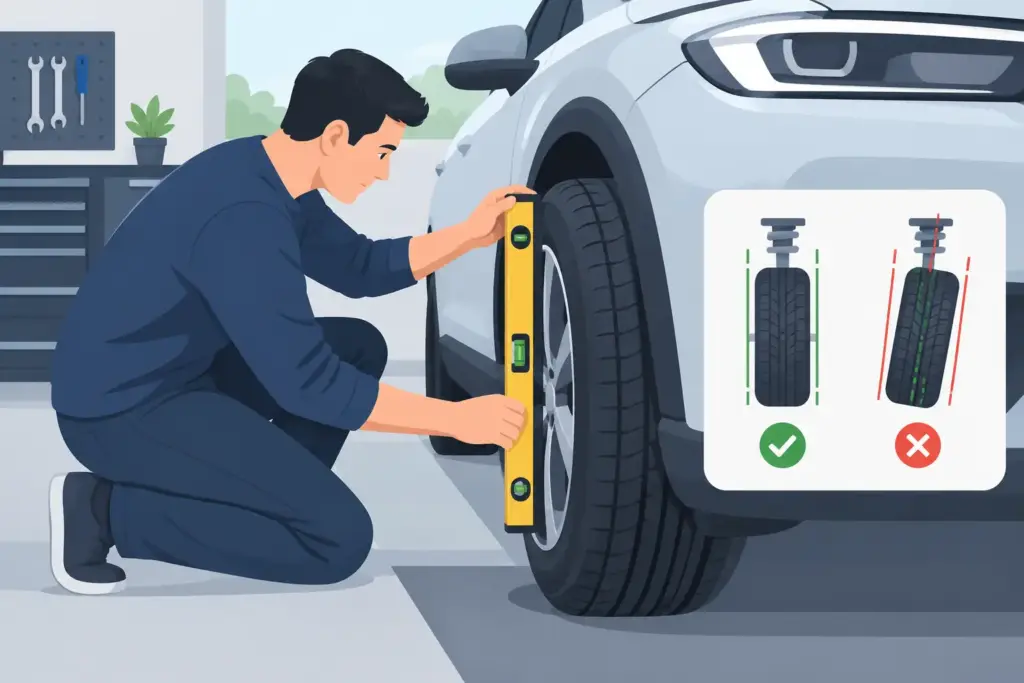
A tire that looks slightly tilted can tell you a lot about what is happening underneath your vehicle. If you are wondering how to check tire camber, the goal is not to perform a full alignment in your driveway. It is to spot a likely problem early, before uneven tire wear, pulling, or suspension damage turns into a more expensive repair.
Camber is one of the angles checked during a wheel alignment. A small amount of inward or outward tilt may be normal for your vehicle. What matters is whether the angle matches the manufacturer’s specification and whether the left and right sides are reasonably consistent. The most reliable answer comes from an alignment rack, but a few careful checks at home can help you decide whether it is time to schedule an inspection.
What tire camber looks like
Camber describes the inward or outward lean of a wheel when viewed from the front of the vehicle. If the top of the tire leans toward the center of the vehicle, that is negative camber. If the top leans away from the vehicle, that is positive camber.
Many modern vehicles use a slight amount of negative camber by design. It can help handling and cornering stability. That is why a wheel that does not look perfectly vertical is not automatically a problem. Excessive camber, a sudden change after an impact, or noticeably different angles from side to side deserves attention.
Camber is only one part of alignment. Toe, which is the direction the tires point when viewed from above, often causes tire wear more quickly than camber does. Caster, another steering-suspension angle, affects straight-line stability and steering return. A home check can point toward an issue, but it cannot replace measuring all three angles together.
Signs you should check tire camber
Start with the tires. They often provide the clearest evidence that an alignment or suspension issue is developing. Look at both front tires and both rear tires, including the inside edges that are easy to miss.
Excessive negative camber commonly wears the inside shoulder of the tire first. Excessive positive camber can wear the outer shoulder. Run your hand lightly across the tread and compare the inside, center, and outside portions. A smooth but noticeably thinner inner or outer edge suggests an angle issue. A cupped, scalloped, or feathered pattern may also point to worn shocks, loose steering parts, or incorrect toe.
You may also notice that the vehicle pulls, feels unsettled after hitting a bump, or no longer tracks straight on a level road. A crooked steering wheel, new vibration, or uneven ride height should not be ignored. After striking a pothole, curb, parking block, or road debris, a wheel can be knocked out of position even when the damage is not obvious from the driver’s seat.
For San Antonio drivers, rough pavement, construction zones, and sudden pothole impacts can all create the kind of jolt that makes a camber check worthwhile.
How to check tire camber with a visual inspection
Park on the flattest surface available, such as a level garage floor or smooth concrete driveway. Set the parking brake, make sure the tires are inflated to the pressure listed on the driver’s door-jamb label, and remove unusually heavy cargo. Roll the vehicle forward and backward a few feet, then let it settle naturally with the steering wheel centered.
Stand 10 to 15 feet in front of the vehicle and look at both front tires at the same time. Then repeat from the rear. Compare the way each wheel leans rather than judging a single wheel in isolation. One side may look visibly more tilted than the other after a hard impact or a worn suspension component.
This method is useful for finding a major difference, but it is not precise enough to tell you whether a vehicle is a fraction of a degree outside specification. Driveways can slope, body panels can create an optical illusion, and some factory suspension designs have noticeable camber by design. Treat this as a screening check, not a diagnosis.
A simple at-home camber measurement
If the visual check raises questions, use a straightedge and a level or digital angle finder for a better estimate. A long, straight piece of metal or a true straight board can work, provided it reaches from near the bottom of the wheel to near the top without resting on the tire’s bulging sidewall.
With the vehicle on level ground and the wheels pointed straight ahead, place the straightedge vertically against the outer face of the wheel or tire. Keep it clear of raised lettering, wheel weights, or a curved section of the sidewall. Hold a level or digital angle gauge against the straightedge and note whether the top leans inward or outward.
A more basic version uses a string with a small weight tied to the bottom. Hold the string just outside the wheel so it hangs straight down, then measure the gap between the string and the wheel near the top and near the bottom. Different gaps show that the wheel is leaning. Repeat the process on the other side under the same conditions.
The comparison is often more useful than the exact number. If one front wheel has a clearly different reading from the other, or if the change appeared after a collision or suspension repair, have it checked professionally. Do not try to correct the angle by adjusting random bolts. On many vehicles, camber is not directly adjustable without checking ride height, control arms, struts, or factory adjustment points.
What can throw off your measurement
At-home readings can be misleading when the surface is not level, the steering wheel is off-center, or tire pressures are uneven. Bent wheels, damaged tires, and decorative wheel lips can also prevent a straightedge from sitting in a true vertical plane.
Suspension position matters too. If a vehicle has recently been lifted, lowered, loaded heavily, or raised on a jack, the angles may change as the suspension settles. A weak spring, damaged strut, bent control arm, worn ball joint, or shifted subframe can affect camber without the alignment itself being the original cause.
That is why a reputable shop inspects suspension and steering components before finalizing alignment settings. Setting the numbers without finding a bent or loose part can lead to repeat tire wear and a vehicle that still does not drive correctly.
When a professional alignment check is the safer choice
Schedule a professional inspection promptly if you see exposed cords, a deep worn strip on one tire edge, a bent wheel, fluid leakage from a strut, or a vehicle that pulls sharply. Those conditions can affect traction and braking, particularly during rain or emergency maneuvers.
An alignment check is also a smart next step after collision damage. Even a low-speed impact can transfer force through a wheel, tire, steering knuckle, control arm, strut, or rear suspension component. Cosmetic repairs may restore the outside appearance, but the vehicle should also be evaluated for alignment and suspension damage when the impact involved a wheel or corner of the vehicle.
At RWORKS, a proper suspension and alignment assessment focuses on the cause as well as the reading. If a part is bent or worn, replacing it before alignment helps protect your tires and gives the adjustment a better chance of lasting. For insurance-related collision repairs, documenting that related damage can also help make sure necessary repairs are not overlooked.
Do not use tire wear alone to diagnose camber
Inside-edge wear is a strong clue, but it does not prove camber is the only issue. Incorrect toe can scrub a tire quickly, while weak shocks can cause cupping. Underinflation tends to wear both outer shoulders, and overinflation can wear the center of the tread. Tire rotation intervals, driving habits, and worn suspension parts all influence the pattern.
If the tread is already badly worn, replacement may be necessary even after the alignment is corrected. An alignment protects the next set of tires, but it cannot restore rubber that has already been worn away. Checking the spare tire age and the condition of the tires on the opposite axle is worthwhile as well, especially on all-wheel-drive vehicles that may require closely matched tire sizes and tread depths.
A quick home camber check can give you useful evidence, especially after an impact or when one tire is wearing faster than the others. But your tires are too costly, and your vehicle’s handling too important, to rely on a driveway measurement when something looks wrong. If the angles seem uneven or the tire wear tells a concerning story, have the vehicle inspected before the next long commute turns a small correction into a full set of tires.