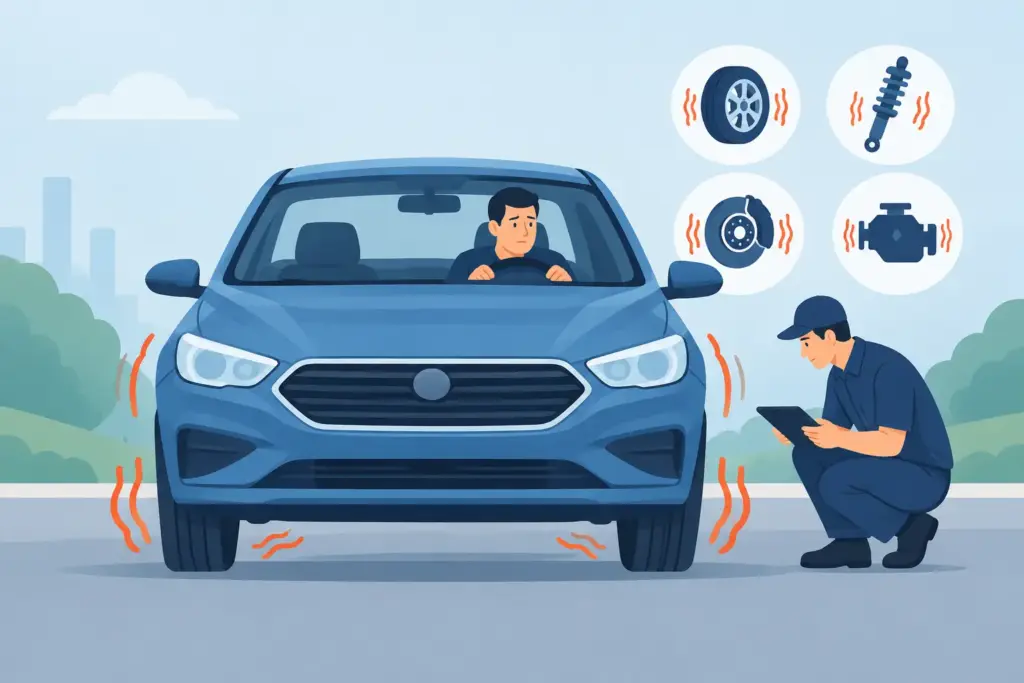
A vibration that starts on the drive home from work can be easy to dismiss, especially if your vehicle still steers and stops normally. But car vibration causes range from a simple wheel-balance issue to tire damage, worn suspension parts, brake trouble, or collision-related alignment damage. The pattern matters: where you feel the shake, when it happens, and whether it is getting worse all give a repair professional useful clues.
A vehicle does not need to be undrivable for a vibration to deserve attention. Addressing it early can protect your tires, improve handling, and help prevent a smaller repair from turning into a more expensive one.
The Most Common Car Vibration Causes
Vibration is usually the result of a rotating or moving component that is out of balance, worn, bent, loose, or no longer aligned correctly. The most likely cause changes based on speed, braking, acceleration, and the location of the sensation.
Tire balance problems
If the steering wheel begins to shake at highway speeds, often around 50 to 70 mph, an improperly balanced wheel and tire assembly is a common explanation. Tires and wheels are balanced with small weights so they rotate evenly. When a weight falls off or a tire wears unevenly, the assembly can create a noticeable shake.
A balance service is often straightforward, but it should not be treated as an automatic answer. A technician should also inspect the tire itself for uneven wear, bulges, separated internal belts, puncture repairs, and sidewall damage. Balancing a damaged tire may reduce the symptom temporarily without addressing the safety issue.
Worn, damaged, or unevenly worn tires
Tires are the first point of contact between your vehicle and the road, so they are frequent contributors to vibration. Cupped tread, flat spots, irregular wear, or a tire with internal damage can make the vehicle feel rough even at lower speeds. You may feel the vibration in the seat, floor, or steering wheel depending on which tire is affected.
A quick visual check can be helpful. Look for a visible bulge, unusually low tread in one area, or tread that feels scalloped when you run your hand across it. Do this only when the vehicle is parked safely. If you find a bulge or see cords showing through the tire, do not keep driving on it.
Uneven tire wear also raises a larger question: why did the tire wear that way? Misalignment, weak shocks or struts, and damaged suspension components can wear out a new set of tires far sooner than expected.
Bent wheels after potholes or curb impacts
San Antonio roads, construction zones, potholes, and an unexpected curb strike can bend a wheel enough to cause a persistent shake. Alloy wheels are especially susceptible to bending from a hard impact, although any wheel can be damaged.
A bent wheel may cause vibration at a specific speed, a slow air leak, or both. Sometimes the damage is obvious. Other times, it is only visible when the wheel is removed and checked on balancing equipment. If the vibration began immediately after an impact, tell the shop exactly what happened. That detail can shorten the diagnostic process.
Alignment and suspension damage
An alignment concern does not always create a vibration on its own, but it can lead to tire wear that does. More significantly, a collision, pothole impact, or curb strike can damage suspension and steering parts while also changing alignment angles.
Watch for a vehicle that pulls to one side, a steering wheel that is no longer centered, wandering at speed, or clunking over bumps. These symptoms can point to worn or bent components such as control arms, tie rods, ball joints, wheel bearings, shocks, or struts. Because these parts affect how your vehicle responds in an emergency maneuver, inspection is worth prioritizing.
Brake rotor or brake component issues
A shake that occurs mainly when you press the brake pedal has a different likely source. Brake rotor thickness variation, excessive rotor runout, or problems with brake hardware can produce a pulsing brake pedal or a steering-wheel shudder during braking.
Many drivers call this “warped rotors,” but the right repair depends on the condition of the rotors, pads, calipers, and surrounding components. Replacing pads without examining the full brake system can leave the original problem in place. If braking causes a severe shake, a pull, grinding, burning smell, or reduced stopping confidence, have the vehicle inspected promptly rather than waiting for the next routine service.
Driveline or axle problems under acceleration
Does the vehicle feel smooth while coasting but shake when you accelerate? That pattern can point to driveline components. On front-wheel-drive vehicles, a worn CV axle or inner CV joint may create vibration under load. Rear-wheel-drive and four-wheel-drive trucks can develop vibration from a driveshaft, universal joints, differential components, or driveline angles.
These issues are not always obvious from the driver’s seat. The vibration may be felt through the floor or seat rather than the steering wheel, and it can change with vehicle speed, engine load, or whether the vehicle is towing. A professional road test and inspection help separate axle or driveline concerns from tire and wheel problems.
Engine, transmission, or mount concerns at idle
If the shaking is most noticeable while stopped at a light or when shifting into drive, the source may not be the wheels at all. Rough engine operation, a misfire, worn engine mounts, or transmission mounts can send vibration through the cabin.
This type of vibration may be accompanied by a check engine light, a rough idle, poor acceleration, or an unusual exhaust note. A flashing check engine light is more urgent because it can indicate a misfire severe enough to damage the catalytic converter. In that situation, limit driving and arrange an inspection as soon as possible.
How the Location of the Shake Can Help
The driver’s description is one of the best diagnostic tools available. You do not need automotive terminology to be helpful. Simply note when the vibration appears and where you feel it.
A steering-wheel shake often points toward front tires, front wheels, front suspension, or front brakes. A vibration in the seat or floor may be more consistent with rear tires, a rear wheel, or driveline components. A whole-vehicle shake at idle suggests an engine or mount concern. These are starting points, not guarantees, since vibrations can travel through the chassis and feel different from one vehicle to another.
Pay attention to whether the vibration occurs at one speed, over a range of speeds, only while braking, only while accelerating, or even when parked. Also mention recent work, new tires, a collision, a pothole strike, or a curb impact. Small details can prevent unnecessary parts replacement.
When a Car Vibration Needs Immediate Attention
Some vibration can wait for a scheduled appointment, particularly a mild highway-speed shake with no other warning signs. Other situations call for faster action. Avoid driving if you notice any of the following:
- A tire bulge, exposed tire cords, a rapid loss of air, or a wheel that appears visibly damaged.
- Severe steering-wheel shake, difficulty controlling the vehicle, or a sudden pull to one side.
- Vibration combined with grinding noises, smoke, a burning smell, or a brake pedal that feels abnormal.
- A flashing check engine light, especially when the engine is running roughly.
- New shaking immediately after a collision or a major pothole impact.
If your vehicle is safe to move but the vibration is growing stronger, do not keep testing it at highway speed. Slowing down and arranging a professional inspection is the safer choice.
What a Proper Vibration Inspection Should Include
The best repair begins with diagnosis, not guesswork. A thorough inspection may include a road test, tire and wheel inspection, wheel balancing, brake evaluation, and checks of steering, suspension, alignment, and underbody components. Depending on the symptom, the technician may also inspect axles, wheel bearings, engine mounts, or scan for engine fault codes.
There is a practical trade-off here. The least expensive fix is not always the right first fix if the underlying damage has not been identified. For example, replacing a worn tire without correcting a bent suspension component can lead to the same uneven wear again. Clear explanations, photos when appropriate, and an estimate before repairs help you make an informed decision.
For San Antonio drivers, RWORKS can inspect vibration concerns connected to collision damage, suspension issues, alignment problems, and visible wheel or body damage. The goal is to identify what changed, explain the repair path clearly, and return your vehicle with handling that feels stable and predictable.
A smooth ride is not just about comfort. When your car starts communicating through a new vibration, listening early gives you more options, helps protect the parts around it, and makes every trip feel more secure.