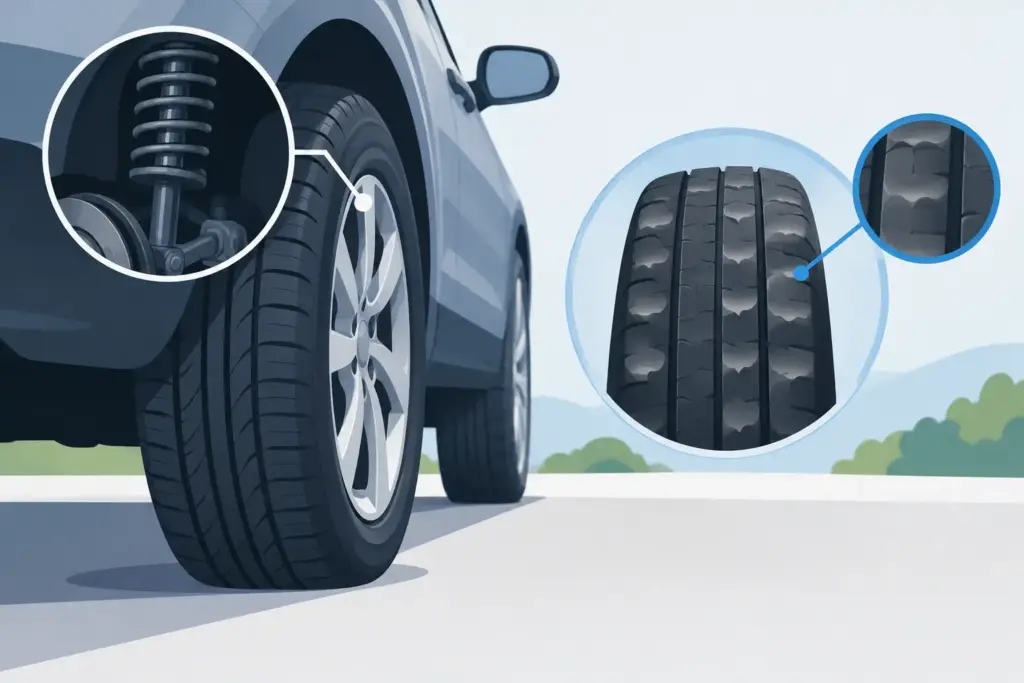
A tire that feels loud, rough, or strangely uneven can turn an ordinary San Antonio drive into a warning sign. So, can suspension cause tire cupping? Yes. Worn or damaged suspension parts can allow a tire to bounce instead of maintaining steady contact with the road, creating the scalloped, high-and-low tread pattern known as cupping.
Cupping is not just a cosmetic tire issue. It can make a vehicle noisier, reduce ride comfort, affect wet-weather traction, and shorten the life of a tire that may otherwise have had plenty of tread left. The good news is that a careful inspection can identify whether the suspension is the cause, or whether another issue is contributing to the wear.
Can Suspension Cause Tire Cupping? The Short Answer
Your suspension is designed to keep each tire planted against the pavement while absorbing bumps, turns, braking forces, and road imperfections. When a shock, strut, spring, control arm, bushing, or other component is worn, loose, or damaged, the tire may briefly lose consistent contact with the road surface.
That repeated bouncing can wear isolated patches around the tire’s circumference. Instead of a smooth, even tread surface, you may see or feel a series of dips and raised sections. This is commonly called tire cupping, though technicians may also refer to it as scalloped wear.
Shocks and struts are frequent suspects because they control spring movement. A weak shock does not always leak or cause an obvious handling problem right away. It may simply lose its ability to dampen motion effectively, allowing the tire to hop over rough pavement. On San Antonio roads, where potholes, uneven surfaces, and construction zones can be part of the commute, that extra movement can add up quickly.
Suspension Problems That Can Lead to Cupped Tires
Worn shocks or struts are one of the most common causes, but they are not the only suspension concern. A vehicle’s ride and tire contact depend on several parts working together. If one is loose, bent, or worn beyond specification, tire wear can become irregular.
Ball joints and control arm bushings, for example, help hold the wheel in its intended position. When they develop play, the wheel can shift slightly as the vehicle hits bumps or changes direction. Worn tie rod ends can create a similar problem at the steering linkage. A damaged wheel bearing may also allow unwanted movement that affects how the tire meets the road.
Springs matter as well. A broken, sagging, or improperly installed spring can change ride height and suspension geometry. That change may place extra stress on other components and alter alignment angles. After a collision, curb strike, or hard pothole impact, it is especially important to inspect for bent suspension pieces rather than assuming the issue is limited to a tire or wheel.
Alignment Is Related, But It Is Not Always the Whole Story
Drivers often hear that an alignment will fix uneven tire wear. Alignment is essential, but it does not solve every cupping problem.
Incorrect camber, toe, or caster can absolutely wear tires prematurely. Excessive negative or positive camber tends to wear an inside or outside edge. Incorrect toe often creates a feathered tread pattern that feels sharp in one direction and smooth in the other. Those patterns are different from classic cupping, although a vehicle can have more than one type of irregular wear at the same time.
If a suspension part is loose or bent, an alignment may not hold. A shop can set the numbers correctly while the vehicle is on the alignment rack, but worn parts can allow the angles to shift again during normal driving. That is why the right process is to inspect the suspension first, repair any failed components, and then perform a precision alignment.
Other Causes of Tire Cupping to Rule Out
Suspension trouble is a leading possibility, but a complete diagnosis should not stop there. Tire cupping can result from several conditions, sometimes working together.
An out-of-balance wheel can create a repeating vibration that wears the tread unevenly. A bent wheel, common after a pothole or curb impact, can also prevent the tire from rolling smoothly. Tires that are underinflated, overinflated, poorly rotated, or mismatched across an axle may wear in ways that resemble suspension-related damage.
Tire construction and tire age can play a role, too. A damaged belt, internal tire defect, or tire that has been driven for too long with a vibration may develop irregular wear. On trucks and SUVs, aggressive tread patterns can naturally make minor irregularities easier to hear, but they should not be dismissed if the ride has changed.
This is why replacing shocks alone, or installing new tires without checking the vehicle, can be an expensive partial fix. If the underlying source remains, the new tires may begin wearing the same way.
Signs You May Have Cupped Tires
Cupping is often easier to feel than to see at first. With the vehicle safely parked, run your palm lightly across the tread from front to back and around the tire. A healthy tire should feel relatively smooth. A cupped tire may have alternating raised and low sections, almost like shallow waves.
Road noise is another common clue. Drivers sometimes describe it as a humming, growling, or helicopter-like sound that gets louder with speed. Because the noise comes from the tire tread meeting the road, it can be mistaken for a failing wheel bearing. A professional inspection can separate the two.
You may also notice vibration through the steering wheel, seat, or floor, especially at highway speeds. The vehicle could feel less settled over bumps, dip excessively after a road imperfection, pull to one side, or wander during braking. None of these symptoms proves that the suspension is the cause, but together they are a good reason to schedule an inspection.
What a Proper Inspection Should Include
A useful diagnosis looks beyond the visible tread. The technician should inspect all four tires for wear pattern, tread depth, sidewall damage, and signs of a separated belt. Wheel condition, balance concerns, and tire pressure should be checked as well.
The suspension and steering inspection should look for leaking or weak shocks and struts, loose ball joints, worn bushings, damaged control arms, tie rod play, broken springs, and bearing movement. If the vehicle has recently been in an accident or struck a pothole, checking for bent components is especially important.
Once any mechanical issues are addressed, the alignment should be measured and adjusted to the vehicle manufacturer’s specifications. A road test can then help verify that the vehicle tracks properly and that obvious vibration concerns have been resolved.
At RWORKS, the goal is not to sell a repair based on a guess. It is to identify the condition causing the wear, explain what is needed, and help you make a practical decision about repair, alignment, and tire replacement.
Can Cupped Tires Be Saved?
It depends on how deep the irregular wear is and how much usable tread remains. Mild cupping may become less noticeable after correcting the source, rotating the tires when appropriate, and driving enough miles for normal wear to smooth the surface slightly. However, the noise may remain for a while.
Severe cupping generally cannot be repaired. Rotating a badly cupped tire may move the noise to another position on the vehicle, but it will not restore the missing tread. If the tread is worn close to replacement depth, the tire has internal damage, or the pattern is affecting handling and wet-road performance, replacement is usually the safer choice.
When replacing tires, do not overlook the reason the old set wore unevenly. Repairing the suspension issue and performing an alignment before or alongside tire replacement protects the investment in the new tires.
When to Schedule Service
Do not wait for a tire to become completely bald before having irregular wear checked. Schedule an inspection if you hear new tire noise, feel a repeating vibration, see scalloped tread, or notice that the vehicle rides differently after a collision, pothole impact, or curb strike.
Catching a weak strut, loose steering component, or alignment issue early may prevent further tire damage and help preserve predictable handling. A tire tells a story about what is happening where your vehicle meets the road. Listening to that story early can save you from replacing the same problem twice.