A bumper can look nearly perfect after a minor impact and still leave your vehicle’s safety technology out of position. That is why knowing how to test ADAS sensors matters after a collision, curb strike, windshield replacement, suspension repair, or even a heavy hail repair. Advanced Driver Assistance Systems are designed to help with braking, lane guidance, blind-spot awareness, parking, and more – but they can only work as intended when their cameras, radar units, and related components are properly aimed and calibrated.
For most drivers, a basic visual and function check is helpful. A complete ADAS test, however, requires professional diagnostic equipment and manufacturer-specific calibration procedures. The goal is not just to turn off a warning light. It is to make sure your vehicle can accurately recognize the road, other vehicles, pedestrians, and lane markings when it counts.
What ADAS Sensors Do
ADAS is not one single part. It is a network of cameras, radar sensors, ultrasonic parking sensors, modules, wiring, and software that work together. Depending on the vehicle, those components may support forward collision warning, automatic emergency braking, adaptive cruise control, lane departure warning, lane-keeping assist, blind-spot monitoring, rear cross-traffic alert, and parking assistance.
The front camera is often mounted near the rearview mirror behind the windshield. Radar sensors may sit behind the front grille, bumper cover, or emblem. Rear radar units are commonly located behind the rear bumper. Parking sensors are visible as small circular components in the bumper.
That placement makes these systems especially vulnerable after collision damage. A small change in bumper position, a cracked bracket, a replaced windshield, or an alignment issue can affect what a sensor sees. In San Antonio, intense sun, road dust, heavy rain, and debris can also temporarily interfere with cameras and radar sensors.
Warning Signs That Your ADAS Needs Attention
A dashboard warning is the clearest sign, but it is not the only one. Some vehicles may display messages such as “Front Camera Unavailable,” “Radar Blocked,” “Lane Assist Unavailable,” or “Pre-Collision System Malfunction.” Others may simply turn off a feature without making the problem obvious.
Pay attention to changes in how the vehicle behaves. If adaptive cruise control no longer detects vehicles consistently, lane assistance stops recognizing lane lines on clear roads, or parking alerts sound when no obstacle is nearby, the system should be inspected. Blind-spot indicators that stay on, fail to illuminate, or work only intermittently also deserve attention.
A warning message does not always mean a sensor has failed. Dirt, bug residue, mud, snow, condensation, a windshield sticker, or a temporary weather condition may be blocking the sensor. Still, if the warning remains after cleaning the vehicle and driving in normal conditions, do not assume the system will correct itself.
How to Test ADAS Sensors With Safe Driver Checks
Drivers can perform a few basic checks before scheduling service. These steps will not replace calibration, but they can help identify an obvious issue and give your repair professional useful information.
Inspect the Sensor Areas
With the vehicle parked, look over the windshield camera area, front grille, bumper, side mirrors, and rear bumper. Check for cracks, dents, loose trim, missing covers, paint buildup, moisture, and visible misalignment. A bumper that has been pushed inward even slightly may have affected a radar sensor or its mounting bracket.
Clean camera lenses and sensor surfaces using products appropriate for your vehicle. Avoid scraping, pressing, or applying harsh chemicals to a sensor cover. If an emblem houses radar equipment, treat it carefully. A damaged or aftermarket emblem can affect radar performance on some models.
Check the Dash for Messages and Indicators
Start the vehicle and look for warning lights or messages related to collision avoidance, lane assistance, parking sensors, adaptive cruise control, or blind-spot monitoring. Then review the vehicle settings screen to confirm those features have not been accidentally switched off.
If your vehicle recently had body work, windshield work, wheel alignment, suspension repairs, or battery service, mention that history. Some vehicles store diagnostic trouble codes even when the warning light is no longer active. Those codes can point a technician toward a communication, power, alignment, or calibration problem.
Test Features Only Under Normal Driving Conditions
On a clear day, drive on familiar roads and observe whether the system functions normally. Lane-related features generally need visible lane markings. Forward cameras may struggle in glare, fog, heavy rain, darkness, or on roads with faded paint. Radar systems can also become limited in severe weather.
Use adaptive cruise control only as instructed in your owner’s manual and only where traffic conditions allow. Do not try to test automatic emergency braking by driving toward another vehicle, wall, person, shopping cart, or cone. These systems are driver aids, not a substitute for attentive driving, and an improvised test can cause a serious accident.
Parking sensors can be checked at low speed in a clear area, but avoid relying on them to judge exact distance. Listen for inconsistent alerts, false warnings, or sensors that fail to detect nearby objects. If something does not seem right, stop testing and schedule an inspection.
Why a Scan Tool Is Not a Full ADAS Test
A diagnostic scan is an essential first step, but it does not prove that every ADAS sensor is correctly aimed. A scan tool can identify trouble codes, communication errors, sensor faults, voltage issues, and certain calibration status problems. It may confirm that a module is online, but an online module can still be aimed incorrectly.
For example, a front radar sensor may have no fault codes after a bumper repair while being just a few degrees off center. That small angle can change its detection area and affect adaptive cruise control or automatic braking performance. A camera may also operate without a code while interpreting the road inaccurately because the windshield was replaced or the vehicle’s ride height changed.
This is why reputable collision repairs include a repair plan that considers scanning before and after repairs, component inspection, wheel alignment when needed, and ADAS calibration according to the vehicle manufacturer’s procedures.
When Professional ADAS Calibration Is Needed
Calibration may be required after more than a major accident. The exact requirement depends on the vehicle make, model, year, and systems equipped, but professional calibration is commonly considered after:
- Front or rear bumper repair or replacement
- Windshield replacement or repair near the forward-facing camera
- Radar, camera, grille, mirror, headlight, or sensor replacement
- Suspension, steering, ride-height, or wheel-alignment repairs
- Airbag deployment or collision damage near sensor locations
- Diagnostic trouble codes or ongoing ADAS warning messages
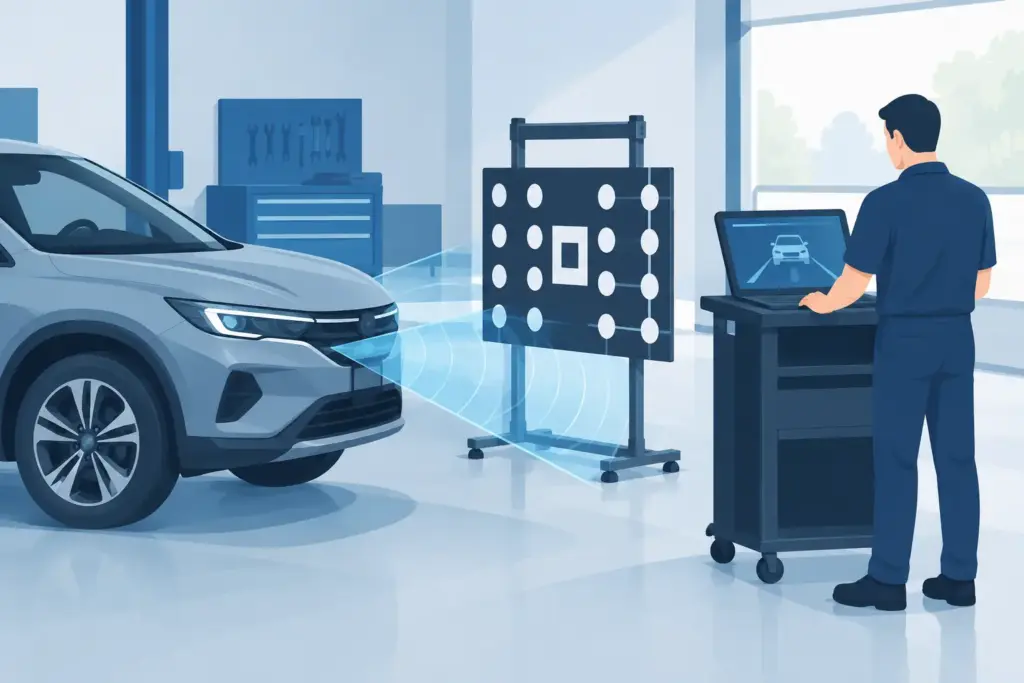
There are two main types of calibration. Static calibration is performed in a controlled shop environment using targets, measuring equipment, and a level surface. Dynamic calibration requires a technician to drive the vehicle under specific road conditions while the system learns or confirms its reference points. Some vehicles require one method; others require both.
The process needs more than a flat-looking floor and a generic scanner. Correct tire pressure, vehicle ride height, alignment angles, fuel level, target placement, software procedures, and sensor mounting all matter. Skipping those details can leave a system technically cleared but not properly calibrated.
Choose Repair Quality Over a Quick Reset
After an accident, it can be tempting to focus only on visible body damage or the lowest estimate. But modern collision repair is also a safety-system repair. A repaired bumper, windshield, or suspension component may look right while ADAS components behind it still need testing and calibration.
Ask the repair facility whether it performs pre-repair and post-repair scans, how it determines calibration requirements, and whether it documents the completed calibration. A clear answer is a good sign. You should also receive an explanation if a feature is limited because of an unrelated sensor issue, aftermarket equipment, or existing damage.
At RWORKS, collision and alignment repairs are approached with the full vehicle in mind, not just the panel you can see. Clear communication matters because drivers deserve to understand what was repaired, what was tested, and what is needed to return their vehicle safely to the road.
If an ADAS warning appears after a collision or repair, do not wait for it to become an emergency. Schedule an inspection, bring any dashboard messages to the technician’s attention, and keep using your own judgment behind the wheel until the system has been properly evaluated.